
Last modified on:
When it comes to food, cheap isn’t always cheerful. Studies have linked diets high in ultra-processed foods to health problems such as diabetes, high blood pressure, certain cancers, coronary diseases, and obesity, to name a few.
But, as we covered in a previous article, buying fresh food can be expensive. Our how to shop on a budget guide will take you through how to get as much fresh food in your diet as possible without breaking the bank. Highly and ultra-processed foods are relatively new to human diets, and if they’re already being shown to increase health risks, think about how impactful these diets will be for the next generation.
In this article, we’ll cover how to read food labels so you can understand exactly what you’re buying, and whether it is actually good value for money.
The traffic light system
On the front of most packaged food, you’ll find a little nutritional label coloured like a traffic light. The Front of Pack nutrition labelling scheme was first introduced by the Department of Health to encourage people to make healthy dietary choices. You can tell at a glance if something is good for you or not: a row of green? Put it in your basket. A row of red? Think again, sunshine. Let’s take a look:
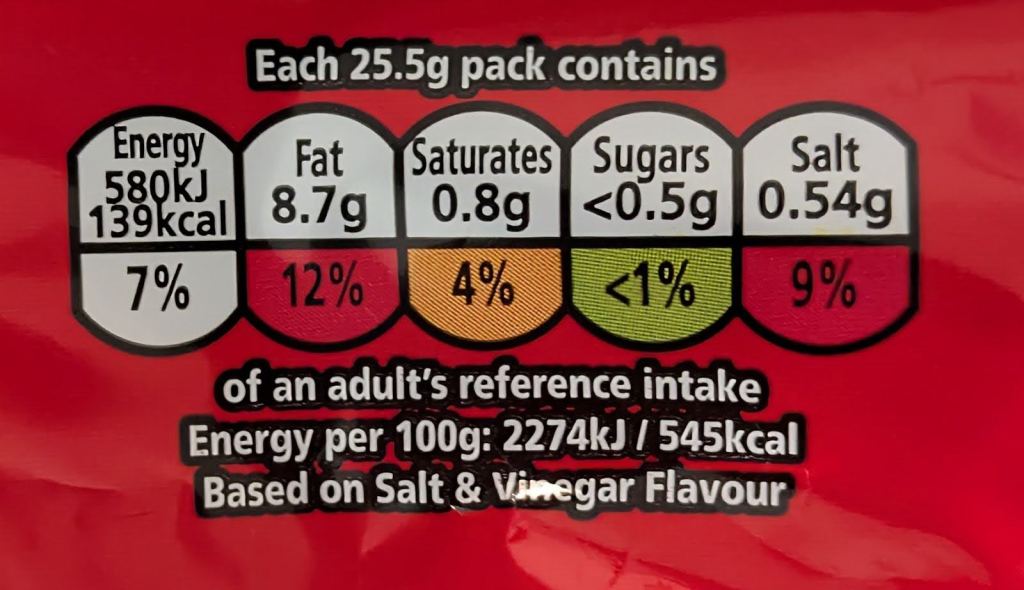
You’ll see the label has been broken down into 5 sections: Energy, Fat, Saturates, Sugars, and Salt.
Per serving of this product, you’d be consuming 12% of your daily Reference Intake of fat. The total fat for an adult, per day, is recommended at 70g. After eating a bag of these crisps, you’ll be left with 61.3g of fat for the day – which is roughly equivalent to 8 pints of whole milk.
The Reference Intake for salt is 6g/day – you’d have 5.46g left for the day, roughly a teaspoon.
To look at it simply:
Red – Eat occasionally, and when you do eat it, do so in smaller amounts
Amber – Not too bad, you can eat often
Green – Fill your boots
The more green, the healthier the food.
How to read nutritional information on the back of the packet
Unlike the traffic light label above, having the nutritional info on the back of the packet is a legal requirement.
Let’s take a look at the label on the back of Tesco’s Spicy Chorizo slices:
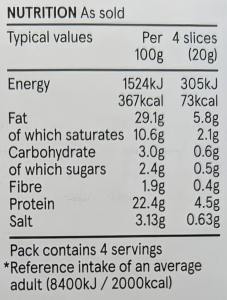
The right hand column tells you the recommended portion size, in this case, four slices. From four slices, you’ll consume: 5.8g fat, 2.1g saturated fat, 0.6g carbohydrates, 0.5g sugar, 0.4g fibre, 4.5g protein, and 0.63g of fat.
If you were to eat a 100g of this spicy chorizo, look at the left hand column of numbers.
When trying to work out whether a product is good value, it’s best to look at the ingredients list. Our article on best value sausage rolls goes into more detail about comparing the composition of ingredients, to make sure the ingredients you’re paying for are the ones you’re eating.
What do these numbers mean?
To give the quantities on the back of a packet context, you’ll need to know what the daily reference intakes are for each. Using data from the British Nutrition Foundation, Reference Intakes are as follows:
Energy – 8,400kJ, 2,000kcal
Fat – 70g
Saturates – 20g
Carbohydrates – 260g
Sugars – 90g
Protein – 50g
Salt – 6g
*These numbers are a guide, and depending on your activity levels, age, gender, and medical requirements, your daily intake will differ.
Now, when you’re shopping, you’ll be able to work out what’s healthy and what’s not. When you’re meal planning you’ll be able to make sure what you’re cooking is balanced, and doesn’t exceed your recommended daily intake allowances.


