
Last modified on:
*We may earn some pocket money through the Amazon affiliate links on this page
While the supermarket baking aisle might be full of packet cake mixes, the sugar-free options are limited to a grand total of two. For diabetics who aren’t confident bakers, you can choose this Betty Crocker Sugar-Free Vanilla Cake, or the brand’s only other sugar-free offering, a chocolate cake.
We reviewed the chocolate version a while ago, but now we’re giving the vanilla mix a try. With many matching ingredients and instructions, our hopes were high.
We tested how easy it was to make, whether the baking instructions were correct, and how the final cake looked and tasted. But don’t worry, we didn’t only have diabetics eat a slice, we also asked non-diabetics for their opinion, too.
Ingredients
Like the Betty Crocker Sugar-Free Chocolate Cake, the vanilla cake mix contains the majority of the ingredients you need to make the cake.
The off-white powder contains the flour, sweetener, powdered fat, and raising agent; all that you need to add is water, oil, and eggs.
Seeing as you can pick the sugar-free vanilla cake mix up for £3 at Tesco, it’ll still be far cheaper than buying all of the ingredients to make a sugar-free cake from scratch. Chances are you’ll already have oil and eggs in your cupboard, and if not, it’s possible to buy both while on a budget.
Since we only had sunflower oil, that’s what we used, and, notably, the box doesn’t name a specific type of oil. A lucky omission for any budget bakers who baulk at the price of olive oil. (Us included.)
Our trusty bottle of sunflower oil gave 80ml to both Betty Crocker sugar-free cake mixes, and as you’ll read further down, didn’t compromise the vanilla flavouring, or, indeed, did it alter the taste of the chocolate version.
Now onto the sweetener. Unlike if you were baking from home, the Betty Crocker cake mix doesn’t use whole food alternatives to white sugar, it uses a sweetener called maltitol instead.
According to diabetes.co.uk, maltitol is around 90% as sweet as sucrose with significantly less calories. As maltitol is non-cariogenic, it isn’t broken down by oral bacteria, meaning it is slowly absorbed during the rest of the digestive process; the rise in blood glucose matches the slow absorption rate.
For diabetics, this means a maltitol-sweetened cake won’t create a blood glucose spike: its glycemic index of 35 is around half that of white sugar (65). Of course, diabetics should still note the calories and carbohydrates and calculate insulin accordingly.
Method
You’ll need:
- Mixing bowl
- Whisk/stand mixer
- Jug
- Spoon
- Cake tin
- Parchment paper
- The ingredients listed on the box (80ml water, three medium eggs, 80ml oil)
From box to baking tin, the method is simple: empty the mix into a bowl, add the extra ingredients, mix, mix, mix, and then pour into a greased baking tin.
We followed the method exactly. We mixed 80ml of water with 80ml of sunflower oil in a measuring jug, which we then poured into a mixing bowl containing the vanilla cake mix. On top, we cracked in three medium eggs.
Then, with bowl under arm, we whisked until the mixture was smooth and completely lump free. It didn’t take long at all, a mere two to three minutes. The resulting mix had a glossy finish and quite a gloopy texture.
Baking
As per the instructions, we preheated the oven to 180C.
We lined the base of our 8-inch baking tin with a roundel of parchment paper and lightly greased the sides with some unsalted butter. Once the tin was prepared, the gloopy cake mix was poured in – the dregs of the mix were encouraged in with a spoon – and evened out.
Into the oven it went. We set a timer for 34 minutes, the low end of Betty Crocker’s 34-38 minute time frame. Even though the chocolate version took 40 minutes in our oven, we didn’t automatically assume the vanilla cake would follow suit, and luckily so: the vanilla cake had risen and had cooked through after 35 minutes.
The five minute difference in cooking time we can’t explain. The oven, the temperature, and the preheat were the same for both cakes. The ingredient lists only differed in flavourings, we used the same cake tin, and the volume of the mixture matched exactly. I guess we’ll never know.
We left the cake to cool before removing it from the tin. The exterior crust crumbled lightly as we did so, however the cake’s structure and shape remained intact; no edges broke away and the cake didn’t sink in the middle.
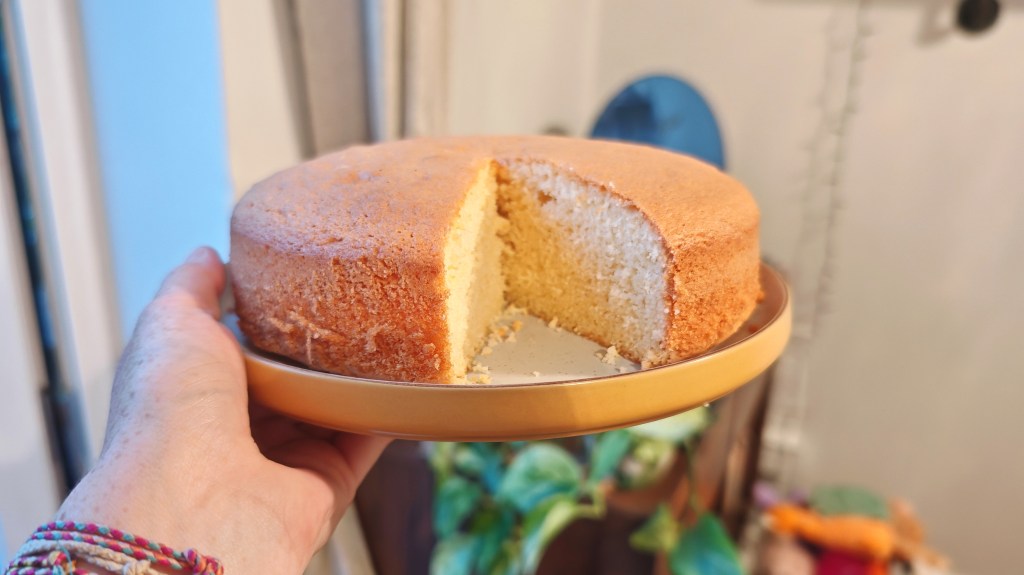
It wasn’t overly golden as maltitol doesn’t caramelise, so while the crust was darker that the centre, the top didn’t have the same colouring a victoria sponge made with caster sugar would.
Would we make the Betty Crocker Sugar-Free Vanilla Cake again?
If we were pushed for time or in need of a sugar-free cake while broke, we would choose to make the Betty Crocker sugar-free vanilla cake again. While getting the vanilla version out of the tin and slicing it up, we noticed it was a bit more crumbly than the sugar-free chocolate cake; it held its shape, so don’t worry about your slice disintergrating in your hand.
In our taste test, we had one diabetic and four non-diabetics give it a go.
One of the non-diabetic taste testers summarised: “Mmm, it’s nice. Quite vanilla-y and you can’t taste the sweetener as much as the other one.” (*In reference to the chocolate Betty Crocker.) The texture, she thought, was just like a normal cake.
Our diabetic taste tester, yours truly, agreed. The cake was light, soft, and felt nice on the tongue. And, like in other bake-tasting, the diabetic didn’t notice any aftertaste from the sweetener; the non-diabetics, however, had mixed responses. The first taste-tester, above, didn’t note any aftertaste, the other three, however, did.
Our ‘How to boil an egg‘ photographer and videographer, Harry, commented that his slice was “very vanilla-y” and “smelled strongly of vanilla”. On the upside, he couldn’t work out whether the cake was sugar-free by mouthful alone, he had to specifically ask if the cake had sugar in it. His review wasn’t all complimentary, however: “I can’t work out whether it’s dry or not.” Perhaps a result of the sweetener, perhaps because the powered mix didn’t contain enough fat. As he was the only one to mention dryness, we ruled out the cake being overbaked as the cause. He also mentioned an aftertaste.
The final two taste testers included Cherie, who lead her feedback by pointing out the aftertaste, describing it as “potentially the sweetener, but it tastes very similar to baking powder”.
In another win for Betty Crocker’s Sugar-Free Vanilla cake mix, Cherie and our final taste tester, both commented on the cake having a strong vanilla flavour. They liked the soft texture and that you could eat it on its own, without the help of cream or custard. The final tester did mention the flavour would compliment a layer of jam, just to switch up the textures.
Stored in tightly wrapped tin foil, the cake was still fresh three days later.
So, if you’re after a sugar-free vanilla cake mix, choose Betty Crocker. If you prefer your vanilla flavour to be more subtle, shop around for a different mix.